




In today’s digital world, businesses collect and store vast amounts of Personally Identifiable Information (PII)—customer names, Social Security numbers, financial records, and more.
However, as cyber threats become more sophisticated, protecting this sensitive data has become a critical challenge. According to the 2023 Cost of a Data Breach Report, the average data breach cost reached $4.45 million, underscoring businesses’ financial and operational risks.
A Costly Lesson: The Equifax Data Breach
A notable example of the devastating consequences of poor PII security is the 2017 Equifax breach. A single unpatched vulnerability in the Apache Struts web application allowed attackers to access 147 million individuals’. The breach remained undetected for months, ultimately costing Equifax $1.4 billion in settlements and severely damaging its reputation.
This incident highlighted fundamental security failures, including:
- Unpatched vulnerabilities: Delayed software updates created an entry point for attackers.
- Weak encryption: Sensitive data was exposed without adequate protection.
- Poor access controls: Overly broad permissions allowed unnecessary data exposure.
- Delayed breach detection: The intrusion went unnoticed for 76 days, amplifying the damage.
- Ineffective incident response: The lack of a structured response plan worsened the crisis.
Equifax is not an isolated case—many businesses face similar challenges when securing PII. So, how can companies protect themselves?
How to Build a Strong PII Protection Framework
No business is immune to cyber threats, but a robust security framework can significantly reduce risks. Here’s how companies can safeguard PII and stay ahead of potential breaches.
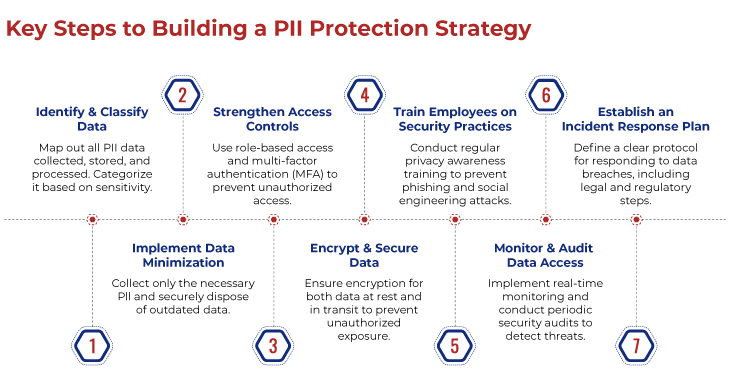

Beyond financial and operational setbacks, legal compliance is a major concern following a breach. Legal Support World assists businesses in cyber incident documentation, regulatory compliance, and breach notification processes as required by HIPPA, GDPR, CCPA, and other relevant laws.
Impact of Implementing a Robust PII Security Strategy
A well-structured PII security framework doesn’t just mitigate risks—it transforms how organizations manage data, protect customers, and ensure compliance. By adopting the measures outlined, businesses can achieve the following tangible and strategic benefits:
1. Reduced Risk of Data Breaches
By proactively locating, classifying, and managing PII, organizations can minimize attack surfaces. Encryption ensures that even if data is compromised, it remains unreadable, and access controls prevent unauthorized entry.
Example: Tools like Varonis help in PII discovery and classification, ensuring sensitive data is identified across systems. Symantec Encryption secures data both at rest and in transit, reducing unauthorized access incidents.
2. Strengthened Compliance with Regulations
Strict adherence to data protection frameworks like GDPR, CCPA, and HIPAA is easier with automated consent management, access control, and retention policies. Ensuring compliance helps businesses avoid penalties and maintain consumer trust.
Example: OneTrust automates consent tracking and privacy rights enforcement, while TrustArc streamlines privacy impact assessments and audit trails, reducing compliance errors.
3. Improved Incident Response & Faster Breach Detection
A well-structured incident response plan enables businesses to react swiftly to security threats, limiting financial and reputational damage. Real-time monitoring tools detect anomalies before they escalate.
Example: Splunk provides AI-driven security analytics that detect threats in real time, while IBM QRadar offers automated breach detection and rapid response.
4. Enhanced Data Privacy & Customer Trust
Privacy-enhancing technologies like pseudonymization, anonymization, and secure storage reinforce a company’s commitment to protecting user data, leading to stronger customer relationships.
Example: AWS Macie uses machine learning to detect and secure PII in cloud storage, while DataGuard automates data privacy processes to ensure compliance and safe handling of customer data.
5. Minimized Insider Threats & Unauthorized Access
Role-based access control (RBAC) and multi-factor authentication (MFA) significantly reduce the likelihood of insider threats and unauthorized access.
Example: Okta restricts data access based on user roles, and Duo Security adds an extra layer of protection with MFA, reducing unauthorized logins.
6. Optimized Data Governance & Lifecycle Management
Structured data inventory, retention policies, and automated data deletion improve governance while reducing storage costs and compliance risks.
Example: Collibra helps businesses track and manage PII across repositories, ensuring proper governance, while BigID automates data discovery and lifecycle management, reducing storage costs by eliminating redundant data.
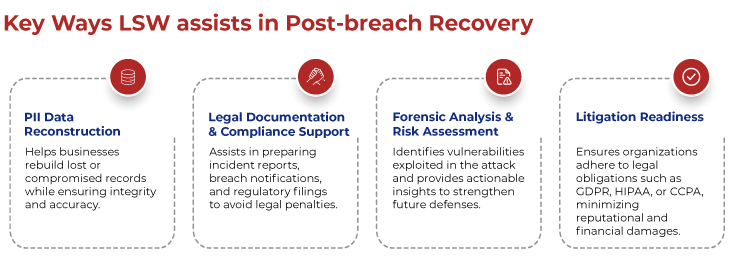
Even with the most robust security measures in place, no system is completely immune to cyber threats. When a breach occurs, businesses must act quickly to recover lost data, meet compliance requirements, and mitigate legal risks.
Due to the complexity of compliance and post-breach obligations, expert legal support becomes essential. Legal Support World (LSW) provides businesses with structured documentation and compliance solutions to mitigate regulatory risks.

Final Thoughts
The evolving cyber threat landscape makes PII protection more critical than ever. From implementing proactive security measures to recovering from an attack, businesses must adopt a multi-layered approach to safeguard sensitive information.
Key Takeaway: Prevention is always better than cure, but in case of a breach, rapid response and structured recovery efforts can significantly reduce financial losses, legal repercussions, and reputational damage.
By combining technology, compliance frameworks, and cybersecurity incident response services from LSW, businesses can not only secure PII but also build resilience against future cyber threats—protecting both their customers and their long-term credibility.
