



Contract breaches rarely happen overnight—they build through overlooked clauses, unclear obligations, and missed signals.
Contracts are the silent engines behind every serious business relationship. They outline expectations, define contractual obligations, and offer a shared understanding of risk. But even the strongest agreements are only as effective as their management.
In today’s fast-paced, high-stakes landscape—where deliverables are complex and timelines are tight—contracts often end up breached. Sometimes by oversight. Sometimes with intent. Either way, the consequences are real—and measurable.
That’s where contract lifecycle management steps in—not just as a legal necessity, but as a strategic function. Without active lifecycle management, contracts turn into static documents—ripe for misinterpretation, missed obligations, and downstream contract disputes.
Consider the rising financial toll of data breaches, many of which trace back to inadequate contract enforcement around data handling, vendor accountability, or compliance. In 2024, the average cost of a data breach climbed to $4.88 million. Healthcare alone averaged $9.77 million per breach, holding its place as the costliest sector for over a decade—fueled in part by vague terms, poor visibility, and a lack of real-time oversight.
Breaches of contract don’t just happen in court—they begin long before in the fine print that’s too often missed, mismanaged, or misunderstood.
How Smart Businesses Make Contracts Breach-Proof
Legal actions may compensate for damages—but they rarely undo the business disruption, strained partnerships, or reputational harm. And while courts offer structured legal remedies for breach of contract, the process is costly, slow, and often unpredictable.
That’s why leading businesses are shifting from reactive enforcement to proactive clarity—using contract lifecycle management powered by intelligence.
This approach includes:
- Drafting with precision—not relying on generic boilerplate language
- Flagging vague clauses and compliance gaps before signature
- Monitoring contracts across their lifecycle—not just at renewal time
- Creating visibility into termination triggers, SLA obligations, and change requests
To visualize how breach of contracts typically originate—and where smart checks can neutralize them—see the lifecycle snapshot in Exhibit 1.
Exhibit 1: Breach Triggers and Safeguards Across the Contract Lifecycle
| Lifecycle Stage | Common Breach Triggers | Recommended Preventive Checks |
| Drafting | Vague or unenforceable clauses | Legal review, redlining, and jurisdictional consistency |
| Negotiation | Misalignment on deliverables or SLAs | Clause abstraction and approval loops |
| Execution | Missed milestones, ambiguous responsibilities | Digital contract tracking and automated task alerts |
| Post-signature | Auto-renewals, expired terms, unnoticed changes | Contract repository + clause-level monitoring |
| Amendments | Informal change requests without legal update | Centralized version control and legal revalidation |
What Is a Breach of Contract?
A breach of contract occurs when one party fails to fulfill their contractual obligations—either by doing something they agreed not to, or failing to do something they committed to. The impact varies widely, from operational setbacks to full-scale legal disputes.
Types of Breach:
- Minor (Partial): A delay or deviation that doesn’t compromise the entire contract.
- Material (Major): A fundamental failure that defeats the contract’s purpose.
- Anticipatory: A signal or admission—before the due date—that obligations won’t be met.
While these categories offer clarity in legal terms, real-world breaches often play out in shades of grey, especially when contracts lack specificity or oversight. The fallout can escalate quickly, from internal disruptions to courtroom drama.
One of the most telling examples? The legal face-off between tech giant Apple and its star engineer, Gerard Williams.
The Case That Shook Silicon Valley: Apple vs. Gerard Williams
To understand why contract violation matters—and how risky it can be—look no further than the infamous Apple v. Gerard Williams case.
Williams, Apple’s lead chip architect and brain behind the iPhone’s A7 and A12x processors, was accused of breach of employment contract when he secretly began building a competing venture, Nuvia, while still employed.
Apple claimed he not only misused proprietary knowledge but also poached employees to support the new company—violating loyalty and non-solicitation clauses. Williams fired back, arguing the contract was unenforceable under California law.
Though the lawsuit was eventually dropped in 2023, the message was loud and clear: even the most innovative companies can be blindsided by poorly defined, inadequately managed contracts.
Contract breaches rarely happen overnight—they build through overlooked clauses, unclear obligations, and missed signals. At, Legal Support World (LSW), our contract review services go beyond the basics, offering redlining, clause abstraction, and lifecycle support that help prevent contract disputes before they escalate.
Legal vs. Equitable Remedies: Know the Difference
Before diving into specific legal remedies for contract breach, it’s important to understand how the legal system categorizes them. These fall broadly into two buckets—legal and equitable remedies, each serving a different purpose depending on the nature of the breach. Exhibit 1 below offers a side-by-side breakdown to clarify these distinctions at a glance.
Exhibit 2: Understanding the Two Categories of Remedies in Contract Law
| Type | Legal Remedies | Equitable Remedies |
| Nature | Financial compensation | Court-ordered actions or restrictions |
| Goal | Address financial loss | Restore fairness or enforce obligation |
| Examples | Compensatory, nominal, liquidated damages | Specific performance, injunctions, rescission |
Top Remedies for Breach of Contract
The law offers a spectrum of legal remedies for contract breach when a contract falls apart, whether due to missed obligations, misuse of proprietary information, or a preemptive withdrawal. These are not interchangeable; each is context-specific and triggered by the nature and severity of the breach.
1. Compensatory Damages
The most common legal remedy. Courts award monetary compensation to restore the injured party to the financial position they would’ve been in if the breach had not occurred.
In Apple’s lawsuit against Gerard Williams, although specific damages weren’t disclosed, the company sought compensatory relief for alleged misuse of resources and the loss of internal talent.The argument hinged on financial harm tied to Williams’ early departure and competing venture.
2. Specific Performance
This remedy compels the breaching party to fulfill their obligations—used rarely, and usually only when the subject matter is unique (like real estate or proprietary tech).
3. Injunctions
A preventive remedy that stops further harm from occurring. In Apple’s case, an injunction could’ve barred Williams from soliciting employees or using proprietary information while legal proceedings unfolded, particularly if the contract included non-solicitation or non-compete clauses.
4. Restitution
Restores any unfair gain one party received due to the breach. In scenarios where a party benefits from company resources—using internal IP or team bandwidth to develop a competing product—restitution may be pursued to neutralize the unjust enrichment.
This was a critical thread in Apple’s argument: Williams allegedly built Nuvia “on Apple’s dime,” leveraging time and talent meant for Apple deliverables.
5. Rescission
Cancels the contract and releases both parties from future obligations. While not the central ask in the Apple-Williams case, this remedy is typical when a contract is compromised by fraud or fundamental breach such that it no longer serves its purpose.
6. Liquidated Damages
Pre-agreed penalties specified in the contract. These are enforceable only if the amounts are reasonable, not punitive, and are triggered by clearly defined failures.
Clause Snapshot:
“If Party B fails to deliver within 5 days post due date, a penalty of $5,000 per day will apply.”
7. Nominal Damages
Symbolic sums are awarded when a breach occurs, but no measurable financial loss is proven. Courts use this to reinforce that even technical violations matter under the law.
8. Quantum Meruit
Latin for “as much as earned.” Applied when services were rendered without a valid contract or when a contract is voided, but one party still deserves fair compensation.
9. Mitigation of Damages
The injured party must act reasonably to limit further loss, such as finding alternate vendors, stopping further work, or securing interim agreements. Failure to mitigate can reduce damages awarded.
10. Legal Action
Litigation, arbitration, or settlements may be pursued when other remedies fail, or if the breach has long-term strategic consequences.
The Apple-Williams case ultimately became a multi-year legal battle. Though dropped in 2023, it underscores how unclear contractual boundaries can escalate into protracted, public legal disputes—even for industry leaders.
Choosing the right remedy isn’t always straightforward—it depends on the nature of the breach, enforceability of the clauses, and the realistic outcome you seek.
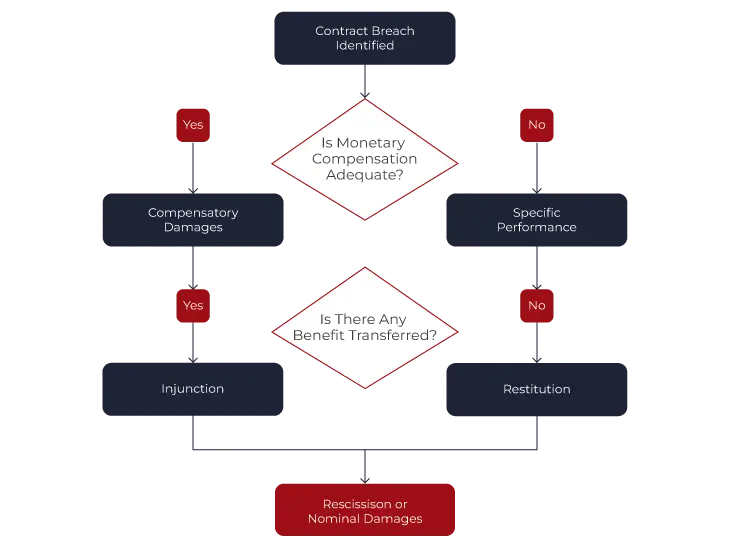
Choosing the Right Remedy — A Decision Flow for Breach Scenarios
In Exhibit 3, you can evaluate which remedy best fits your contract dispute scenario—based on intent, impact, enforceability, and business outcomes.
Exhibit 3: Breach Remedy Decision Path
Conclusion: From Reactive Remedies to Proactive Control
Relying on legal action and remedies to fix contract violations is an expensive, reactive approach—one that cannot recover lost time, strained relationships, or reputational damage.
Contract Lifecycle Management is your strongest defense. It’s a strategic, end-to-end framework that identifies risks early, aligns expectations, and ensures compliance—dramatically reducing breach potential and legal fallout.
If you want to protect your business and turn contracts from a liability into a competitive edge, investing in CLM isn’t optional. It’s essential.
Ready to Make Your Contracts Breach-Proof?
Don’t wait for contract disputes to dictate your legal strategy. Our end-to-end contract life cycle management services – including contract drafting, redlining, clause abstraction, and lifecycle oversight—help you prevent breaches of contract before it begins. Get in touch with our experts today.