



The COVID-19 pandemic last year brought along change and disruption, becoming a lesson for everyone in many ways. Legal professionals, too, learned to meet unique challenges and adapt to new circumstances. During and in the aftermath of the global pandemic, technology has become crucial for lawyers. It helped execute several business continuity plans and strategies — for instance, the big shift to remote working.
According to a Clio survey, 83% of legal professionals (in 2020) viewed cloud technology as necessary for the survival of their law firms. While 76% said working virtually can help streamline workflows and services.
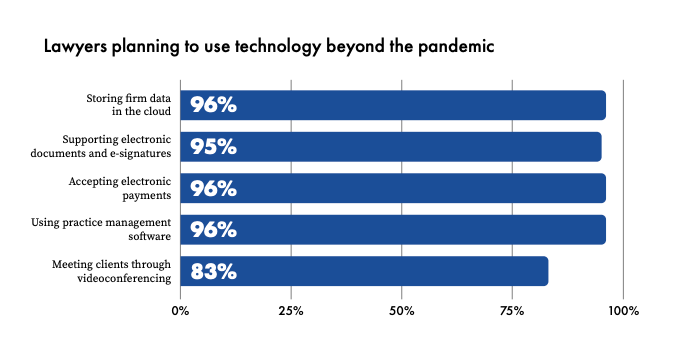
Even before 2020, many law firms were using various technologies; the pandemic simply increased the importance of tech, especially cloud-based solutions like virtual meetings and e-discovery.
In the coming years, factors like the unstoppable expansion of data, cloud adoption, smartphone apps for legal work, and more will significantly influence e-discovery.
E-discovery trends and insights to understand what changes are occurring.
1. Going Beyond Capturing Information
For the past few years, e-discovery’s core focus has been efficient, cost-effective management of identifying, collecting, and reviewing electronically stored information (ESI) to extract valuable insights. Law firms, e-discovery consultants, and vendors have been focused on creating this value. However, e-discovery involves certain risks that can become costly because a single mistake can damage the strength of a well-prepared case.
This has made it necessary for lawyers and law firms to add greater focus toward the fact-finding process. Only by ensuring the facts are genuine and accurately described can lawyers create authentic documents and complete discovery efficiently.

2. The Continuously Growing Variety & Volume of ESI
Companies and individuals use ESI for several purposes; the volume and variety continue to expand exponentially. Cloud-based collaboration platforms integrating tools such as chat, file sharing, and virtual workspaces are now used far more than email.
Moreover, various forms of text messaging are discoverable, and given their flexibility and immediacy, businesses widely prefer them for communication. Adding to this are connected devices — the Internet of Things (IoT) — that leave discoverable information such as location data, time tags, and audio/video recordings.
However, with this, e-discovery risks are also becoming more complex.
Also Read: Is Digital Disruption a Threat or an Opportunity for Law Firms?
3. Technological Developments Change the Dynamics of Discovery
Some companies have now built flexible capabilities for the collection and storage of ESI. For this, many have partnered with reliable firms providing effective e-discovery services using the latest fact-finding technology. And thus, ultimately, it becomes their responsibility to handle the entire process and make effective use of technology.
Utilizing helpful facts from this vast pool of information is the core motive of the discovery process. Here, technology is helping them to use millions of ESI records and develop a factful, defensive narrative early in the matter.
4. Automation is Influencing Cost
Lawyers and law firms providing litigation services understand how costly the discovery process can be. With automation, legal professionals are improving the predictability and efficiency of the process while reducing errors that can become costly. Moreover, false or misidentified documents can lead to delays and complicate prioritization of other crucial work.
Legal professionals now use automation to complete discovery efficiently within defined timelines. Law firms appear to be achieving strong results; perhaps that is why 84% of firms are planning to increase their technology budgets.

5. The Likely-Increasing Adoption of Microsoft 365
Microsoft has developed the Microsoft 365 suite to strengthen enterprises’ abilities to simplify e-discovery and related processes. This is why more organizations and law firms are expected to embrace it. Small and medium-sized organizations are likely to adopt Microsoft 365 to manage e-discovery more efficiently and guide outside counsel on identifying, collecting, and storing ESI.
Given the ongoing development of features in the E3 and E5 models, Microsoft’s e-discovery tools will help law firms gain better cost control.
6. The Era of Cloud-Based E-Discovery Solutions
Recently, large capital investments into various companies that develop e-discovery software will result in more efforts to improving these technologies. Beyond that, these companies will grow their market share quickly. Cloud-based e-discovery solutions are delivered based on SaaS models. This makes it an attractive deal for;
- Law firms that are looking for third-party providers offering all aspects of e-discovery and litigation support services.
- Law firms that are confident about their in-house expertise but do not have the capital required to invest in IT infrastructure and hardware. These solutions can also help companies manage their relationships with outside counsel and control financial and work-related aspects.
7. The Never Stopping Expansion & Evolution of Data
In the last two years, people across the globe have created more data than in any defined time in history. This rapidly expanding and evolving data and its types will continuously bring significant challenges in the collection, storage, review, and analysis phases of the e-discovery lifecycle.
The real challenge comes up when new tools may not be integrated immediately and, furthermore, require additional requests from providers to allow users to download data in application-specific formats. Here, e-discovery solutions will work as a bridge and efficiently collect process, and review data regardless of its type.
In the last 12-15 months, technology has undergone significant changes. Consequently, cell phone text messages can be produced in a file format (that has been traditionally used in the legal sector) with a layout that can appropriately match what the phone displays.
Final Thoughts
Given the changes done in and around e-discovery, the role of the e-discovery attorney (skilled technologist and litigator) is evolving and experiencing increased importance in the industry.
E-discovery attorneys are likely to become way more essential to perform the jobs described below.
- Deciding the scope of ESI collection and preservation
- Developing a legal proportionality strategy
- Mentioning and highlighting supporting facts
- Leveraging the latest tools for technology-assisted review
- Using AI technology to its fullest
Organizations and law firms with skilled e-discovery attorneys who embrace innovations (adoption of AI, automation, and more) can reach the forefront of the legal sector and deliver superior-level services and tremendous value to clients in the long run.
At Legal Support World, we are a team of attorneys and legal professionals who can efficiently fulfill your e-discovery needs. We have been providing top-quality legal services, including litigation support services, to lawyers and law firms worldwide since 2008.
To learn more about our legal process transformation and management solutions, call us today. For any queries, you may also write to us at info@legalsupportworld.com.