



“I want to attract more clients”- the dream of every business owner. And the ultimate solution to excel in the market is “Offer quality service to clients at a much cheaper price.”
Even the legal industry has the same goal and strategy to acquire more clients. But why are they still lagging behind? In a competitive market, legal firms often have difficulty meeting demand due to the higher costs of legal services.
Today, legal firms are also looking for strategic options to squirrel their money while ensuring work quality. As a result, many law firms have explored the benefits of legal process outsourcing services to several offshore law firms globally.
Offshore Legal Process Outsourcing Market
The unavoidable global pandemic that has affected several industries is projected to have an impact on the growth of the legal industry. A recent survey report delivers insights on COVID-19. It emphasizes effects and changes in consumer behavior and demand. It also brings current market forces and dynamics, as well as notable government interventions, into light. The global legal market size for outsourcing legal work is expected to reach a CAGR of 31.8% by 2025. This market value was estimated at $5.2 bn in 2018. According to recent research by Grand View Research, the LPO industry is likely to grow to $38.25 bn. During this growth, eDiscovery might witness the highest growth by 2025.
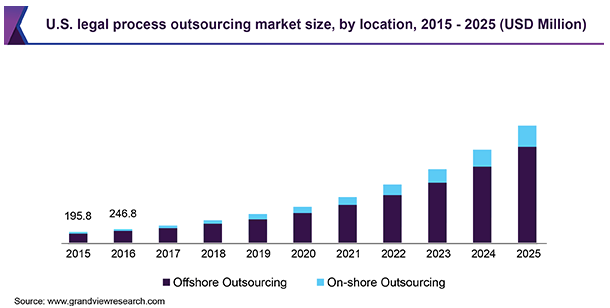
Source
What Ways does LPO contribute to the market growth of legal firms?
Faith and positive reputation of the firm are the greatest factors in acquiring and retaining new and existing clients. Managing legal data is crucial for legal institutions. It holds personal information about the client. Moreover, clients choose a trustworthy lawyer and hand over their cases.
In such scenarios, offshore legal services help law firms in providing quality service by increasing their productivity and operational efficiency. It enables them to focus on their core legal aspects and fulfill their client’s demands. Legal professionals are afraid of losing their jobs. In 2015, 79,000 legal jobs based in the U.S. were estimated to move offshore.
Offshore legal process outsourcing firms have highly qualified professionals who work as required. Hence, they enable law firms to focus more on understanding the client’s cases and improving relationships.
Is Offshoring a Viable Option?
Offshoring is defined as “the moving of various operations of a company to another country for reducing labor costs.” India, Philippines, and China are the main hubs providing outsourcing services to legal firms.
It’s been years now, that many law firms have preferred offshore legal back-office support to streamline their non-core legal processes. However, some legal firms hesitate because they believe that getting jobs done outside their own country can be risky. They have concerns related to confidentiality and security of data, differences in legal systems, and regulatory policies. They consider onshoring or nearshoring a better choice.
Since it doesn’t lower the cost, as wages of those service providers are similar to the in-house team. This means that onshoring is a productive option as they only give law firms time to manage their core aspects but don’t help them reduce their costs. On the other hand, offshoring helps you save money while improving your relationship with your clients.
Key Differences: Onshore vs Offshore Legal Outsourcing
| Feature | Onshore Legal Outsourcing |
Offshore Legal Outsourcing
|
| Location | Outsourcing to a provider within the same country as the client. |
Outsourcing to a provider in a different, often distant, country.
|
| Cost | Higher due to local labor costs and overhead. |
Significantly lower due to lower wages and operating costs in the service provider’s country.
|
| Communication | Easier due to the same language, cultural norms, and minimal or no time zone differences, allowing for real-time collaboration. |
More challenging due to potential language/cultural barriers and significant time zone differences, which can slow down real-time collaboration.
|
| Legal/Regulatory Compliance | Simpler and lower risk as both parties adhere to the same national laws and regulatory frameworks. |
More complex as it requires navigating different international legal systems, data protection laws, and professional regulations.
|
| Talent Pool | Limited to the local talent pool, though expertise is familiar with the client’s domestic legal system. |
Access to a global talent pool, providing a broader range of specialized expertise and large-scale staffing resources.
|
| Control & Oversight | Higher due to geographical proximity, allowing for easier in-person meetings and quality control. |
Lower due to physical distance, requiring more robust monitoring and management systems.
|
Pros and Cons of Offshore Legal Process Outsourcing
As every rose has thorns, in the same way, there are advantages and few disadvantages of offshoring legal services. Let’s start with the pros:
Here are pros:
1. Cost Saving –
In America and European countries, hiring a professional paralegal or litigator to perform certain legal tasks based on their field of knowledge costs a lot more compared to lawyers in India. This enables law firms to hire offshore lawyers at an affordable cost, helping them increase profit margins and improve business efficiency.
2. Available 24/7-
By offshoring, you can gain the advantage of different time zones. For example, if you outsource to India, your night is India’s day, so you can get round-the-clock services for your outsourced tasks and stay ahead of your competitors.
3. Better Focus on Core Business Tasks –
With offshore legal services, you can easily focus on your core operations, including understanding the case, meeting with clients, going for trials in court, and a lot more.
4. Greater Growth Capacity –
Growing your firm will require you to focus on productive tasks rather than worrying about the extra salary expenditures. Through off-shore outsourcing, you become able to cut manpower and infrastructure costs, along with getting professional expertise to manage your unproductive tasks.
5. Ample Future Planning Time –
If you focus too much on daily operations that can be outsourced, you will restrict yourself from dreaming big. Outsourcing legal work provides you with ample time to leave these back office tasks for litigation, contract management, legal research and writing to third-party experts and utilize the time in planning something big for the future.
6. Improved Work-Life Balance –
When you try to manage everything on your own, you end up putting in additional effort during the day and night, too. Hiring a freelance attorney and outsourcing the legal back-office tasks helps manage workflow in a timely manner, helping you maintain your work-life balance.
7. Get Hold of the Desired Cases –
There are multiple times when you will require additional professional expertise to keep your clients satisfied. There is no need to refer such desired cases to others due to the unavailability of professional assistance. Outsourcing lets you enjoy the professional expertise of an experienced attorney, helping you get hold of the cases you like.
8. Increased Output –
In order to increase your output, you need to invest more effort and time. However, this becomes limited when you are trying too hard yourself. Outsourcing extends the number of efforts on your behalf, eventually increasing your work productivity and overall outcome.
Here are a few cons:
1. Data Breaches Due to Poor Confidentiality-
Law firms are very much concerned about their client’s data, and at any cost, they don’t want to lose their client’s trust in their firm. This often stops them from outsourcing legal work; however, offshore legal process outsourcing providers comply with strict regulations when it comes to confidentiality of client information. Before outsourcing, you should go through their privacy policy norms.
2. Cultural Obstacles-
Outsourcing legal work to the international market leads to cultural and language barriers that could affect communication between onshore and offshore legal teams.
3. Hidden Costs-
Most of the time, law firms face hidden cost difficulties while outsourcing, including employee turnover, quality control, vendor profit margins, or rising operating costs. You should ask your provider for a detailed list of their costs for your awareness.
But choosing that one reliable partner is essential from so many options available in the market. Be strong with your decision and keep all the aspects in mind before opting for offshore legal services.
If you are looking for a reliable LPO firm in India, then look no further than Legal Support World. It is one of the leading legal process outsourcing firms helping lawyers and law firms across the world with their reliable legal services. For more information, contact us at info@legalsupportworld.com or call at +1 914 863 9894
Related Blogs:
How Your Company can Grow with Legal Process Outsourcing? – Infographic