



A well-executed SWOT analysis law firm strategy isn’t just a management exercise—it’s a roadmap for legal excellence. Whether you’re launching a new law office or reevaluating your current strategy, understanding your Strengths, Weaknesses, Opportunities, and Threats helps shape smarter decisions, long-term growth, and directly impacts your law firm’s success.
By examining internal factors and addressing weaknesses with honest reflection, a firm can identify potential threats and the biggest threats facing its practice. Recognizing the most important factors objectively ensures that the SWOT analysis is not just theoretical but actionable, helping your legal operations thrive. In this 2025 article, we walk you through how to perform a SWOT analysis tailored for law firms.
What is SWOT Analysis for Law Firms?
A SWOT analysis is an efficient way to evaluate an organization’s strengths & Shortcomings (internal factors) and opportunities & possible challenges (external factors) to it. Typically, companies perform it to strengthen a strategic plan, effectively determining their standing role before proceeding with opportunities and addressing limitations.
For law firms, this analysis is particularly valuable as it provides a clear framework to assess the law firm’s internal competencies and external market dynamics. By discovering strengths, a legal department can leverage its core competencies and unique advantages to enhance its position in the legal industry.
Why is SWOT Analysis Important for Law Firms?
In any business, a business analyst generally performs a SWOT analysis. However, if you have neither a BA team nor a business analyst, being the owner, you should do it yourself or give this responsibility to one of your employees who has excellent analytical skills.
For legal firms is the base of an active and strategic business plan as it allows you to sit with other board members of your firm to discuss its short as well as long-term objectives. Performing a SWOT exercise helps law firms in all practice areas, including family law, to discover key issues and areas for improvement. The best you can bring out from this analysis is opportunities and risk detection. For example, a family law practice might recognize strong client relationships as a strength, while a criminal defense firm could see increased competition as a risks.
It has now become an apparent part of strategic planning; however, there are still many owners who are overlooking it. It is a simple yet compelling method as it can efficiently help in solving several business problems if implemented appropriately. Using the four boxes framework, you can visually organize internal strengths and Shortcomings alongside external opportunities and challenges, making it easier to analyze and act on the findings.
Moreover, it serves as a strategic planning tool that aligns your law firm’s internal capabilities with broader market conditions. This alignment is crucial for developing a marketing strategy that leverages your unique value while addressing Shortcomings and potential risks. For instance, understanding economic downturns or shifts in client expectations allows your firm to adapt proactively rather than reactively. Your marketing efforts can be improved by focusing on the results of the SWOT analysis, such as highlighting your strongest practice areas or addressing gaps in your current outreach.
Ultimately, embracing it empowers your law firm to maintain a market advantage by continuously assessing its internal strengths and external opportunities, tackling shortcomings, and preparing for potential risks. As market conditions change, it is important to revisit the SWOT analysis regularly to action plan for the future and ensure your strategies remain effective. This proactive approach is integral to achieving and sustaining your firm’s success in an ever-changing landscape.
What are the Key Components of SWOT Analysis for law firm?
A SWOT analysis for a law firm focuses on four key components—strengths, weaknesses, opportunities, and threats. Each element highlights a different aspect of the firm’s position, from internal capabilities to external market factors. This structured view helps identify gaps, assess risks, and guide more informed strategic decisions.
Exhibit 1: SWOT Framework for Law Firms
 1. Know More about Your Firm’s Strengths
 1. Know More about Your Firm’s Strengths
Examining strengths means evaluating strong points that already exist within your firm. Note that a significant part of your firm’s strength comes from the excellent and beneficial qualities or characteristics of your employees, while the outside market doesn’t make any difference to it.
Here’s an example to understand this better. Say you have a few attorneys with more than two decades of experience in practicing law; that immense level of experience is a strength. Even if you don’t get any new clients in a month, that strength will remain the same.
Similarly, if you are using third-party legal support services to enhance your operations and lower the workload, the service provider will also be counted as your firm’s strength.
Other strengths can be determined as materialistic strengths, such as up-to-the-mark computer systems providing better operational efficiency and brand image or reputation earned by delivering high-standard client service and bringing satisfactory case outcomes.
Things to focus on while analyzing strengths
- What defines your firm as being better than your competitors?
- Which aspects of your firm get clients’ appreciation?
- What makes your cases and law firm successful?
- What are the key point’s people choose you to have their back?
- Figure Out Your Firm’s Weaknesses
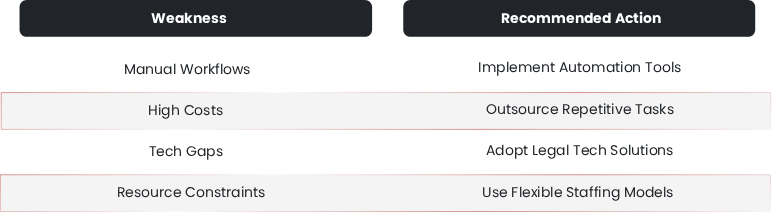
Your firm’s weaknesses also revolve around its internal aspects. Keeping the costs of service low to stay competitive in the legal industry is a weakness. Similarly, depending upon payments from clients to manage operational costs is a bigger weakness.
Other negatives may arise due to not having sufficient staff or appropriate systems for better efficiency. For instance, these days, a lot of lawyers and law firms prefer to use online tools and software for paralegal tasks such as legal case management.
If your lawyers are unaware of such highly helpful tools, it is a weakness alert. Not only is this, but the inefficiency of administrative operations also a contributor to the weaknesses of your law firm.
Weakness Analysis
- In which areas you need to have more knowledge and expertise?
- What were the reasons you had fewer clients in the previous months?
- Which are your firm’s aspects you can’t brag about?
- What are the factors limiting your firm’s efficiency?
2. Figure Out Your Firm’s Weaknesses
Your firm’s weaknesses also revolve around its internal aspects. Keeping the costs of service low to stay competitive in the legal industry is a weakness. Similarly, depending upon payments from clients to manage operational costs is a bigger weakness.
Other negatives may arise due to not having sufficient staff or appropriate systems for better efficiency. For instance, these days, a lot of lawyers and law firms prefer to use online tools and software for paralegal tasks such as legal case management.
If your lawyers are unaware of such highly helpful tools, it is a weakness alert. Not only is this, but the inefficiency of administrative operations also a contributor to the weaknesses of your law firm.
Weakness Analysis
- In which areas you need to have more knowledge and expertise?
- What were the reasons you had fewer clients in the previous months?
- Which are your firm’s aspects you can’t brag about?
- What are the factors limiting your firm’s efficiency?
Exhibit 2: Weakness to Solution Mapping
3. Look for Attainable Opportunities
In SWOT analysis, opportunities are external factors that your law firm depends upon for sustainability. As it requires preparing projections, analyzing opportunities becomes a subjective and somewhat difficult task.
For instance, if your firm is practicing real estate law, a huge housing development project proposed in your area is an attainable opportunity.
If you consider joining hands with another more established firm, you can call it an opportunity. Opportunities also include;
- Having media attention to your firm
- Widely published legal victories achieved by your law firm’s attorneys
This could give a boom to your brand image, resulting in more business from existing clients or/and a growing number of new clients. Spare some time to look around for opportunities; there are probably more than you could have ever expected.
Things to consider while analyzing opportunities
- What are the trends or events that could bring more business to the firm?
- What amendments in the law could have an impact on your business?
- What technological advancements could transform the way you conduct your business?
- Can any of your strengths bring business opportunities?
4. Become Aware Of Threats to Your Firm
This section of SWOT for the legal department identifies things that might later become your firm’s weaknesses. One of the biggest threats for law firms is competition, such as another firm that holds more potential to take advantage of identified opportunities.
New laws might also become a threat to your law firm. Here’s an example to explain the same. Say your law firm provides expert legal services in defense of criminals, and suddenly, some laws decriminalize activities for which you are representing your client; here, you could lose clients due to changes to the laws (external threat).
Threats can also include a slowdown or closure of your clients’ businesses or some of your clients no longer being willing to continue with your services.
Threat Analysis
- What are the possible obstacles to revenue growth?
- What makes your competitor firm get more business than yours?
- How could impending policies negatively affect your firm?
- Do you have cash flow issues?
- Are you stuck with bad debt?
Using Technology to Enhance SWOT Analysis
Today, technology plays a pivotal role in helping law firms conduct a more thorough and effective SWOT analysis. By leveraging digital tools, firms can efficiently gather, organize, and interpret data across both internal and external factors.
According to the American Bar Association Legal Industry Report 2025, over 60% of law firms are increasing their investment in legal technology, with efficiency and productivity cited among the top three priorities. This reflects a clear shift toward data-driven decision-making in legal operations.
Modern software solutions enable firms to automate data collection, track key performance indicators, and visualize trends that might otherwise go unnoticed. Analytics platforms can reveal patterns in client acquisition, case outcomes, and workload distribution, helping firms better understand both strengths and weaknesses. Additionally, firms using technology-driven workflows report up to 30% improvements in operational efficiency, particularly in document management and research.
Technology also supports real-time monitoring of external factors, such as regulatory changes, competitor activity, and market shifts, ensuring that SWOT analysis remains dynamic rather than static.
Ultimately, integrating technology into the SWOT process enables faster insights, greater accuracy, and stronger strategic alignment, which are critical for firms aiming to stay competitive in an evolving legal landscape.
Practical Tips for Conducting an Effective SWOT Analysis
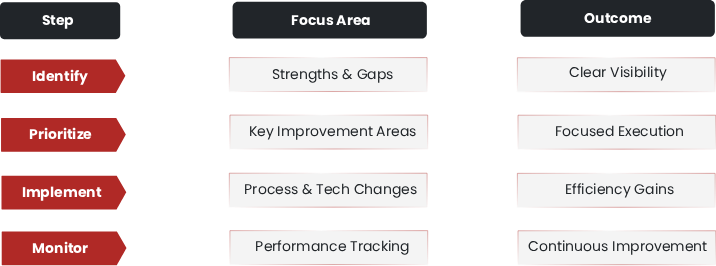
Exhibit 3: Turning SWOT Insights into Action
- In-Depth Analysis
Having intuitions about possible threats is not as effective as researching them. But you should not ignore your instincts; instead, try to find out more about them to understand how they could actually hinder your business. - Priority Should Be There
It is not necessary to do everything based on SWOT analysis results or do everything as per the order. Put each one (Strengths – Weaknesses – Opportunities – Threats) in the list as per the level of importance. Thus, you could highlight your greatest strengths and rectify your biggest weaknesses first. - Be Determined
It is advisable to refrain from responding to every weakness with an excuse. You can only resolve problems in your firm when you actually acknowledge them as problems. - Consider Adopting Technology
Artificial Intelligence (AI) has been helping the law industry in managing specific tasks, such as reviewing documents, which is actually called technology-assisted review (TAR), research, documents, contract analysis, proofreading, and organizing documents.
Not just this, AI-powered software can also help you ensure that the data you are using for SWOT analysis is accurate and authentic. - Know Your Competitive Advantage
Regardless of the reason behind conducting a SWOT analysis for firm, you should know if your firm is giving tough competition to competitor firms or not. Recognize the critical points of services you offer, especially those that your competitors are unable to. - Know Where the Informative Data Is
When assessing strengths and weaknesses, thoroughly examine your firm’s core competencies, value chain, operations, resources, R&D, and organizational culture.
For opportunities and threats, you can assess competition by getting up-to-date information on market changes and trends.
Conclusion
A proper SWOT analysis firm approach gives you insights, not just data. Use it to craft your strategy, prioritize high-impact actions, and update it every 6–12 months.
Looking for paralegal support services? Legal Support World can help you. Contact us today.