


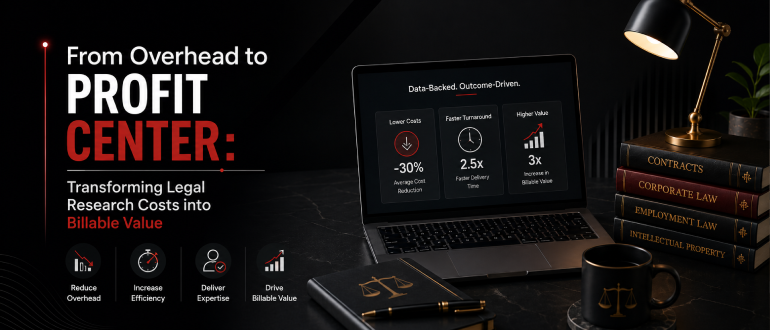
Every law firm has a version of this story: an associate spends six hours researching a nuanced preemption argument, produces a solid memo, and then watches the billing partner write the time down to three hours before the invoice goes out. The work was necessary. The research was good. But half of it never got billed.
Multiply across a firm with ten associates, and you’re looking at a revenue leak that runs well into six figures annually, which is silently, consistently, and largely unaddressed. Legal research costs law firms’ money twice: once when the work is done, and again when it’s discounted off the bill. The firms that figure out how to stop this cycle don’t just save money. They build a new revenue stream.
Why Law Firms Still Treat Legal Research as a Cost Center
For decades, legal research fit neatly into the billable-hour model. Attorneys researched, attorneys billed, and clients paid.
That equation has become harder to sustain.
Today, legal departments scrutinize research charges more closely than almost any other billing category. Anticipating client pushback, many firms write down research time before an invoice is even sent. The result is a growing gap between the value research creates and the revenue firms ultimately realize.
The challenge becomes even clearer when firms look beyond attorney hours and consider the full cost of research.
| Research Cost Drivers | Impact on Firm Profitability |
| Attorney research time | Higher production costs as billing rates increase |
| Partner review and supervision | Valuable billable capacity consumed internally |
| Research-related delays and rework | Reduced matter efficiency and longer turnaround times |
| Pre-bill write-downs and collection losses | Lower realization and reduced revenue recovery |
Research remains essential to case strategy, risk assessment, and client outcomes. Yet many firms continue to treat it as a necessary expense rather than a service that can be delivered more efficiently.
How ro Turn Legal Research into a Profit Center
Improving research profitability is not about billing more hours. It is about changing how research is produced.
One approach is outsourced legal research. Under this model, qualified research professionals handle research-intensive tasks while attorneys maintain responsibility for supervision, analysis, and final legal advice. This allows firms to lower production costs, improve realization, and free attorneys to focus on higher-value client work.
The model is also supported by ethics guidance. ABA Formal Opinion 00-420 permits firms to charge more than the direct cost of outsourced legal services when billed as legal fees, provided the overall fee remains reasonable. ABA Formal Opinion 08-451 further clarifies how firms may recover outsourced service costs and related supervision expenses.
How Outsourcing Flips, the Equation — Cost to Value
The mechanism is straightforward arbitrage: a firm pays a lower rate for research production than it bills for research delivery. The core formula:
(Your Billable Rate – Outsourcing Rate) × Hours Saved = Net Gain
Law firms can save upward of 40% on operational costs by outsourcing routine research functions. Applied across a firm’s annual research volume, the impact is material on three levels simultaneously:
- Freeing associate time for higher-leverage work. Every hour an associate spends on research is an hour not spent on client-facing strategy, business development, or complex drafting. When research is outsourced, associates recover those hours for work that commands full billing rates with lower client resistance.
- Increasing matter throughput. Faster research turnaround means matters close faster, and new matters can begin. A firm constrained by associate research bandwidth that outsources effectively can handle more concurrent matters with the same headcount — directly expanding revenue capacity.
- Speed as a competitive differentiator. LPO providers specializing in research deliver memoranda faster because they focus exclusively on research and maintain extensive databases. In competitive practice areas, faster research capability is a meaningful advantage.
Value Conversion Flow
How a research request becomes billed revenue in three steps:
| STEP 1
Research Request |
▶ |
STEP 2 LPO Delivers |
▶ |
STEP 3 Firm Bills Client |
The firm receives the client’s research need, engages the LPO provider with a structured brief, receives a reviewed work product, and bills the client at the established rate. The spread between cost and billing rate is the firm’s margin.
What the Numbers Look Like in Practice — Real Scenarios
The profit center model looks different across organizations, but the outcome is often the same: lower research costs, better resource utilization, and stronger financial performance.
Scenario A — Small Litigation Firm Managing High-Volume Research
A ten-attorney litigation firm handles dozens of active matters each month, with associates spending significant time on case law and statutory research. Much of that research time is later discounted or written off during billing.
By outsourcing routine research work while keeping attorney oversight in-house, the firm reduces production costs and creates a healthier margin on research-related work. Associates also gain more time for higher-value activities such as case strategy and client engagement.
Scenario B — Mid-Size Firm Entering a New Practice Area
A 25-attorney firm expanding into environmental regulatory compliance needs specialized research support but lacks the volume to justify hiring a full-time specialist. Instead of taking on a fixed salary expense, the firm uses outsourced research on an as-needed basis. This provides immediate access to expertise while keeping costs aligned with client demand.
| Scenario | Organization Type | Challenge | Outcome |
| A | Small litigation firm | Research write-downs reduce profitability | Improved research margins and attorney utilization |
| B | Mid-size firm entering a new practice area | High cost of hiring specialized talent | Flexible access to expertise without fixed overhead |
These examples illustrate how legal research outsourcing can help firms improve profitability, increase capacity, and manage growth without adding significant overhead.
Which Types of Legal Research Translate Best to This Model
Not all research converts equally well to the profit center model. Understanding where to apply it avoids overpromising clients and ensures consistent quality from outsourced providers.
Best fit: High-volume legal research, case law surveys, statutory research, jurisdictional comparisons, and litigation history pulls.
Strong fit: Multi-jurisdiction and niche practice area research where specialized expertise improves speed and accuracy.
Good fit: Contract review, due diligence, legislative history research, and transactional support during peak workloads.
Not suited: Client-specific strategy, privileged case theory development, and matters requiring ongoing attorney judgment.
How Building the Infrastructure Helps to Set Up Research as a Profit Center?
Making this model work operationally requires four components. Firms that have all four in place typically reach a functional profit center model within 60 days.
- Standardized Research Request and Delivery Workflow
Every research engagement should begin with a structured brief: the legal question, jurisdiction, relevant facts, prior research completed, required format, and deadline. Standardization prevents scope creep, enables accurate time estimation, and produces consistent deliverables that are easier for attorneys to review. - QC and Attorney Review Layer
ABA guidance on outsourcing consistently establishes that lawyers must ensure third-party providers perform work capably and protect the confidentiality of client information. This is both an ethics requirement and a quality assurance function. - Billing and Markup Framework
Define in advance how research costs will be handled in client agreements. Options include billing research at a flat research rate (e.g., $200/hour for all research regardless of who performs it), billing at cost plus a fixed percentage markup, or bundling research into flat-fee matter pricing.
The approach generating the most consistent margin is the flat research rate, the firm charges a standard rate that covers LPO cost, supervision time, and margin. This is transparent to the client, easy to administer, and removes the per-matter negotiation that creates billing friction. - Tracking ROI Month-Over-Month
Build a simple dashboard tracking: total research hours delivered by LPO providers, total LPO cost, total research revenue billed to clients, and net research margin. Review monthly alongside matter budgets and realization rates.
How to Choose a Legal Research Partner That Supports This Model
The profit center model stands or falls on the quality and reliability of the research partner. Choosing the wrong provider doesn’t just hurt research quality, it creates malpractice exposure and client trust issues.
| Evaluation Area | Strong Indicator | Potential Concern |
| Pricing Transparency | Written rate card and scope provided before engagement | Pricing shared only as broad estimates with no documented structure |
| Turnaround Commitments | Defined SLAs and delivery timelines documented in writing | No clear turnaround commitments or service standards |
| Quality Assurance | Formal QC process with attorney review before delivery | Limited visibility into review procedures or quality controls |
| Confidentiality & Security | NDA, data security policies, and confidentiality protocols in place | Unclear approach to data protection or confidentiality obligations |
| Industry Experience | Verifiable references from law firms in similar practice areas | Limited client references or relevant legal research experience |
Conclusion
Legal research will always be a critical part of legal practice, but it does not have to remain at a cost center. Firms that continue treating research as overhead often face rising labor costs, write-downs, and capacity constraints that erode profitability over time.
By adopting a profit center mindset and leveraging outsourced legal research strategically, firms can reduce research overhead, improve utilization, increase billable capacity, and create a more scalable operating model. The result is not just lower costs, but greater value generated from every research hour.
For firms looking to improve legal research ROI, the opportunity lies in viewing research as a business asset, one that can contribute directly to revenue, client service, and long-term growth.
People Also Ask
Can attorneys charge clients for outsourced legal research?
Yes. Attorneys can generally charge clients for outsourced legal research, provided the arrangement complies with applicable ethics rules and the total fee charged is reasonable. Law firms remain responsible for supervising outsourced work and ensuring clients are billed appropriately.
How do law firms make money on outsourced legal research?
Law firms improve profitability by obtaining legal research at a lower production cost while continuing to provide attorney oversight, analysis, and strategic guidance. This allows firms to reduce internal research costs, minimize write-downs, and allocate attorney time to higher-value billable work.
What is the ABA opinion on billing outsourced legal work?
ABA Formal Opinion 00-420 permits law firms to bill for outsourced legal services as legal fees, provided the total charge is reasonable. ABA Formal Opinion 08-451 further addresses the recovery of outsourcing-related expenses and emphasizes transparency, supervision, and reasonable billing practices.
How do you calculate the cost of legal research per matter?
The cost of legal research per matter typically includes attorney or researcher time, legal database expenses, supervision costs, quality-control reviews, and any outsourced research fees. Tracking these costs separately helps firms measure profitability and identify opportunities for greater efficiency.
What is a legal research profit center model?
Legal research profit center model treats research as a revenue-generating activity rather than a pure overhead expense. The goal is to manage research delivery efficiently, recover appropriate value through billing, and improve overall matter profitability.
How do small law firms reduce legal research costs?
Small law firms often reduce legal research costs by outsourcing routine research tasks, standardizing research workflows, using alternative staffing models, improving matter budgeting, and reserving attorney time for strategic legal work that generates greater client value.