



The legal industry is asking a practical question: Can AI-generated legal research be trusted without verification?
Tools like ChatGPT and Google Gemini are now part of everyday legal workflows. Drafts are fast, research is quick, and turnaround times have improved across firms. Ultimately, operational efficiency has improved across legal workflows
However, a less visible risk is emerging beneath this efficiency.
AI-generated content often carries a tone of certainty, even when the underlying information hasn’t been validated. That’s where the risk begins. In law, a single wrong citation or legal error can directly impact case outcomes.
The challenge in 2026 isn’t just that AI makes mistakes. It’s that those mistakes are becoming difficult to identify.
This creates a growing reliability gap between speed and accuracy. Unfortunately, in legal research, that gap cannot be left unchecked. Perhaps human verification is the only solution that can close that gap, bringing accountability, context, and precision back into AI-assisted work.
Why AI Still Makes Mistakes
AI-assisted legal research has improved speed, but accuracy remains inconsistent—especially in complex, jurisdiction-specific matters. The issue is no longer limited to obvious errors like fake citations. The risks have become more subtle and, therefore, more dangerous in practice.
1. Beyond Fake Citations: “Ghost Precedents” and Jurisdictional Blurring
Recent experience across law firms shows that AI tools can reference real cases but misstate their legal holdings. These are often referred to as “ghost precedents”, cases that exist, but are cited for propositions they do not support.
A 2024 evaluation by Stanford University researchers found that legal AI systems produced incorrect or misleading information in a meaningful share of responses, especially when queries required jurisdiction-specific accuracy or nuanced interpretation.
2. Wrong Rules: Outdated or Misapplied Law
AI models are trained on historical data and do not inherently verify whether a law has been amended, repealed, or recently interpreted differently by courts.
For example, a mid-sized litigation firm using AI to draft a motion relied on a statutory provision that had been amended the previous year. The language appeared correct, but the amendment introduced an exception that materially weakened the argument.
The issue was identified only during partner review, narrowly avoiding a flawed filing. These problems struggle impact accuracy, particularly when laws evolve rapidly, or recent case law alters interpretation.
3. The “Confidence Bias” Problem
One of the most significant risks is not the error itself, but how it is presented. AI-generated responses are delivered with a high degree of linguistic confidence, regardless of their factual accuracy.
The consequences of this dynamic were demonstrated in the Mata v. Avianca case, where attorneys relied on AI-generated citations that later proved to be non-existent. The court imposed sanctions, reinforcing the expectation that legal professionals independently verify all submissions, regardless of how they are generated.
What are the Ethical and Financial Risks of Relying on AI-Generated Legal Research without Validation?
The use of AI in legal research improves speed, but it also introduces risk at the point of reliance. When outputs are used without validation, responsibility for accuracy remains entirely with the legal professional. What appears complete and well-reasoned may still carry gaps that only surface when applied to a real matter.
- Regulatory Expectations and Professional Responsibility
Legal regulators expect lawyers to maintain full control over the quality of their work, regardless of the tools used. The American Bar Association has clarified that professional competence includes an understanding of legal technology and its limitations.
This translates into a simple expectation: any AI-assisted research must be reviewed and verified before you rely on it. Courts assess submissions based on their accuracy and relevance. The method used to prepare the content does not alter that standard. - Financial Exposure and Operational Impact
Once an error enters the workflow, the impact is rarely limited to a single correction. It can affect timelines, increase internal review effort, and create additional cost layers that were not part of the original scope.- Malpractice exposure where incorrect research affects legal strategy or outcomes
- Increased review costs as firms introduce additional validation steps.
- Rework and delays that reduce efficiency and affect delivery timelines
According to LexisNexis (2024), a large share of legal professionals continues to express concerns about the reliability of AI-generated outputs, even as adoption increases. This reflects an ongoing need for human oversight within AI-assisted workflows.
A corporate law firm preparing a compliance advisory used AI to compile recent regulatory updates. The draft was structured, clear, and appeared aligned with current law.
One key compliance threshold, however, had been revised in a recent amendment. The AI output reflected the earlier version. Because the content read clearly and consistently, the discrepancy was not identified during the initial review and was shared with the client.
The issue surfaced during a subsequent internal check, requiring the firm to issue a correction and revisit the advisory. While there was no regulatory penalty, the situation affected client confidence and led to stricter internal review protocols, increasing the time required for similar work.
- Reputational Risk and Client Trust
Legal work is evaluated on accuracy over time. Even a single inconsistency can raise concerns about the reliability of a firm’s processes. Clients expect advice to be current, precise, and defensible, regardless of how it is produced.
Ai-generated errors are not treated any differently from other professional lapses. The expectation remains consistent, and so does the impact on trust.
Validation operates as a control within this process. It ensures that AI-assisted outputs are aligned with current law, relevant jurisdiction, and the specific facts of the matter before they are relied upon.
Why “Human-in-the-Loop” (HITL) is the New Gold Standard
AI can assist with speed and structure, but legal accuracy depends on interpretation, judgment, and accountability. This is where the Human-in-the-Loop (HITL) approach becomes essential. It integrates AI efficiency with human verification, ensuring outputs are not only well written but also legally sound and contextually correct.
1. Nuance vs. Pattern Recognition
AI systems operate on pattern recognition. They identify similarities across large datasets and generate responses based on probability. This works well for drafting and summarization, but legal work often depends on nuance that extends beyond patterns.
Understanding legislative intent, interpreting how a precedent applies to a specific fact pattern, or identifying subtle distinctions between cases requires contextual judgment. These are areas where human expertise remains critical. A statute may appear clear in isolation but take on a different meaning when read alongside judicial interpretation or recent amendments. AI does not independently evaluate these layers; it presents what appears most statistically relevant.
Human review ensures that the legal principle is not only correct in general but also appropriate to the specific matter at hand.
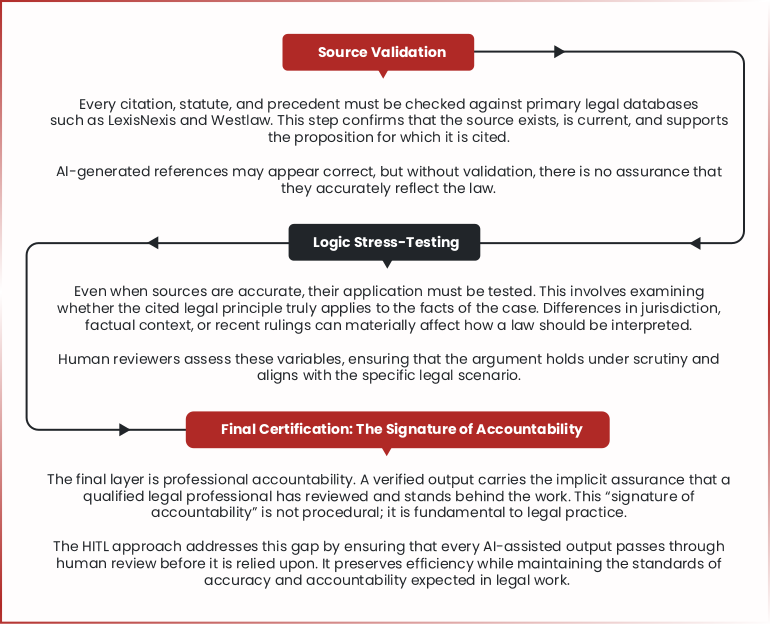
2. The Verification Framework
A structured verification process allows firms to retain the speed of AI while maintaining control over accuracy. This typically involves three key steps:
How Does Legal Support World (LSW) Reduce the Risks of AI-Generated Legal Research?
As AI becomes embedded in legal workflows, the need is not to replace it, but to control its output. This is where Legal Support World (LSW) operates—as a dedicated audit layer that sits between AI-generated drafts and final legal submission.
LSW functions as the Audit Layer
LSW will assist you as a structured verification partner for lawyers using AI. Instead of relying on AI outputs at face value, firms can route drafts through an independent validation process. This ensures that every argument, citation, and legal reference is reviewed before it is used in practice..
The objective is straightforward: retain the speed of AI while removing the uncertainty associated with its outputs.
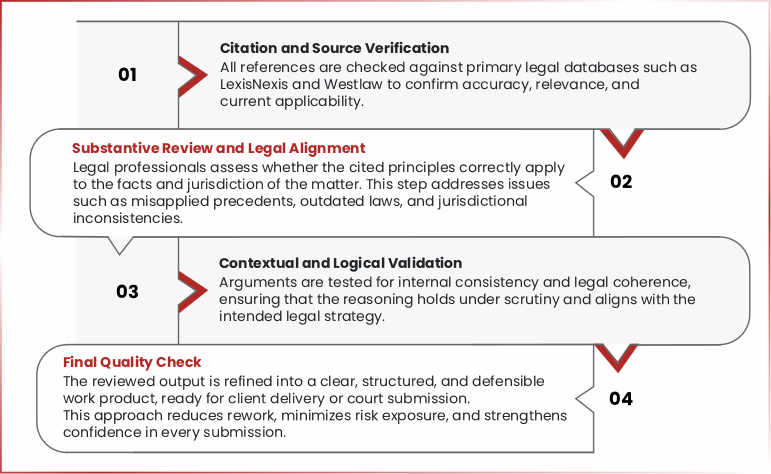
Our Process: From Draft to Defensible Work Product
LSW follows a multi-step review approach designed to align AI-generated content with legal standards:
Conclusion
AI has changed how legal work is produced, but the expectation of accuracy remains unchanged. Drafting may begin with technology, but validation determines whether that work can be relied upon.
Firms that integrate human verification into their AI workflows are better positioned to manage risk, maintain credibility, and deliver consistent quality. The combination of speed and oversight creates a more controlled and dependable process.
For firms looking to strengthen this balance, Legal Support World provides a practical solution. Get in touch with us today.
